
Bats
Bats
Bats (Chiroptera)
Through the presence of both urban and rural areas, the West Midlands is sufficiently suitable to support roosting bats, potential roosting features, and trees, buildings, barns, sheds, hedgerows and other potential roosting sites.
From the 17 breeding bat species spotted all over the country, many appear in the West Midlands, including common pipistrelle bats, Bechstein’s bats and Daubenton’s bats.
Our team of professional ecologists are able to guide you through the planning process even if local bat populations impact your development plans, whether that involves preliminary roost assessments (PRAs), bat emergence and re-entry surveys (BERSs) or additional considerations such as ongoing site supervision or applications for mitigation licences from Natural England.
Bat Survey Requirements
Bat Survey for Planning Permission
Active Legislation Protecting Bats
Mitigation and Compensation for Bats
If a development site has any chance of housing UK bat species, the local planning authority will require a bat survey before making any form of decision regarding planning applications.
Once an ecological consultant has completed bat scoping surveys and any further surveys as applicable such as bat activity surveys, determined an absence or presence of bats, and produced a bat report, planning consent should be attainable from the local authorities.
Whenever proposed works involve a building or roof feature that could support bats, a full bat survey will prevent building works from being halted by the local council during key planning decisions, especially when it comes to efforts to secure planning permission and potentially submit a bat licence application.
All bats situated across the UK are fully protected by law. Such local and European legislation prevents anyone from actions that would deliberately kill, injure or disturb bats or damage, destroy or obstruct bat roosts.
Certain laws were no longer applicable following Brexit, but European protected species in England such as bats remain within strict parameters through the Conservation of Habitats and Species Regulations 2017 and the Wildlife and Countryside Act 1981.
A bat survey is a material planning consideration because it is a criminal offence to potentially disturb bats and their roosts. The local council’s planning department is required to ensure compliance with UK law, leading to professional bat surveys.
During every stage of detailed guidance for a suspected bat roost, the survey data will contribute to the creation of mitigation and compensation measures, assisting the present species of bat, the developer, and the local authority.
Compensation and mitigation measures are worked into all ecological services, with such further information as bat droppings, dead bat carcasses, feeding remains, gable ends, hanging tiles, loft space, ridge tiles, roof tiles, roof voids, slate roofs and urine stains dictating the suitable mitigation work.
The chosen next steps for mitigation and compensation of suitable habitats on the site will vary based on the development plans, the specific locations affected by the planned works, and even the time of year.
Types of Bat Surveys
Preliminary Roost Assessment (PRA) / Bat Scoping Survey
Bat Emergence Survey / Bat Activity Survey / Bat Emergence and Re-Entry Survey (BERS) / Presence and Absence Survey / Dusk and Dawn Survey
Preliminary Roost Assessment (PRA)
Bat Emergence Survey
Bat Survey Report
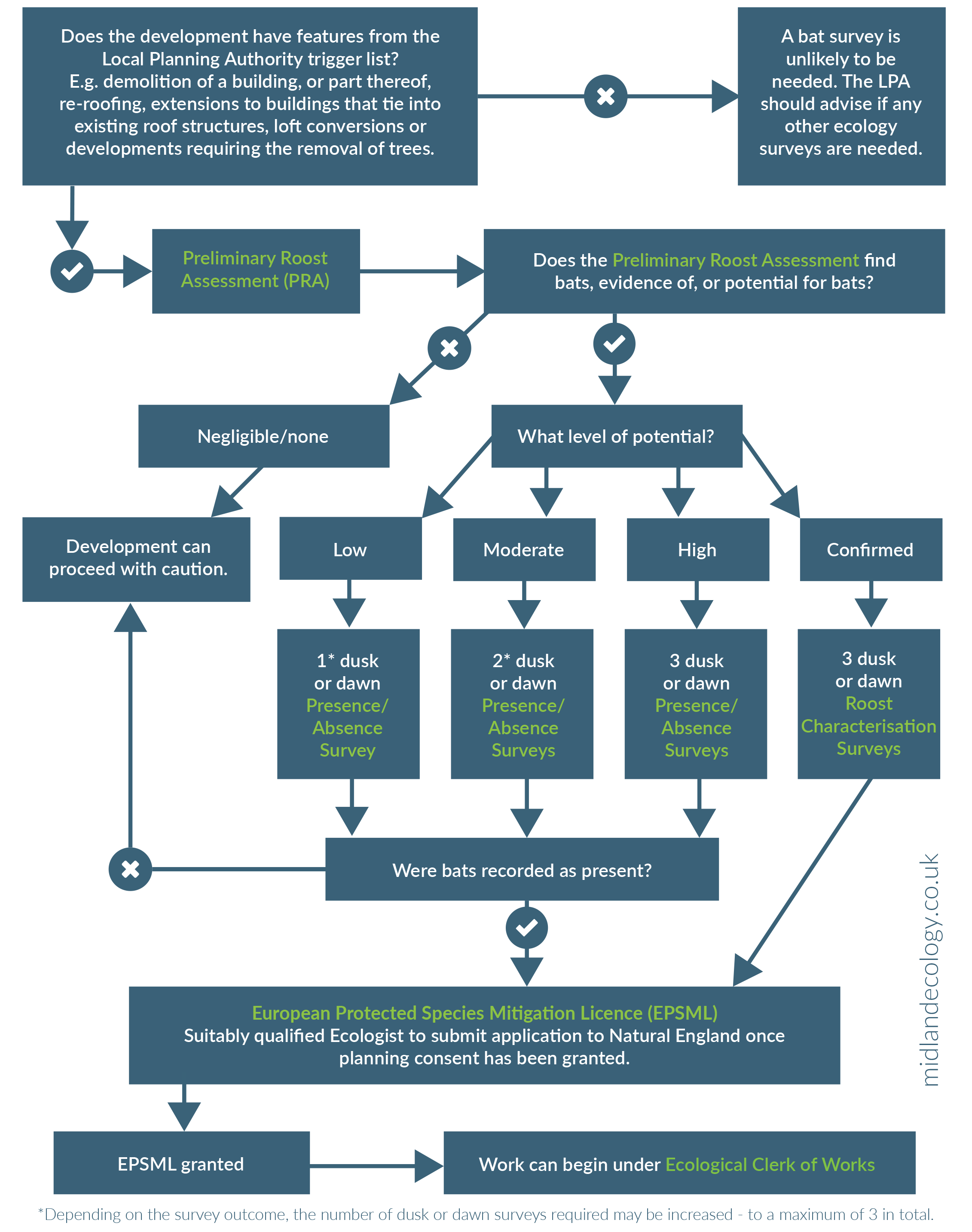
Stage 1 in the bat survey process, the daytime inspection is the most commonly requested service.
A qualified ecologist conducts a thorough internal inspection and checks external features for signs of bat presence or bat roost potential.
All potential impacts on bats and entry areas are considered, such as spaces in cavity walls, gaps in ridge tiles and missing roof tiles.
In rare circumstances, we can confirm a likely absence of bats after one survey, but the site visit may also confirm a need for further bat surveys.
If a bat is found, high suitability for bats to roost or activity from a known roost, stage 2 will consist of a night-time assessment to analyse back tracking, behaviour patterns and key data by recording dawn entry and dusk emergence.
Each bat specialist will use thermal imaging cameras, static detectors and other devices to help with retrieving information from the site.
From common species of bat to priority species of bat, the outcome of a bat emergence survey will confirm which species they are, where they are and what they’re doing, guiding the ecological consultant towards the right mitigation scheme.
A detailed report comes after both types of bat survey.
Most importantly, a bat report will be vital in giving the local planning authority everything needed to allow planning approval.
It will also contain all results from the bat survey, including the mitigation plan. Adequate mitigation could be the creation of bat boxes or a roof feature designed for bats to roost.
The planning officer will be given assurances in the report that the development will not negatively affect bats.
Bat Survey Methodology
Bat Survey Equipment
Bat Consultants
Bat Survey Techniques
From installing bat boxes as replacement resting places for crevice-dwelling species of bat, to using radio tagging technology as a method of tracking bats throughout natural and man-made structures. And from DNA analysis for determining certain species and population numbers to using bat detectors and activity transects to find bats.
Our team have all of the necessary specialist equipment to guarantee that you won’t get a more detailed assessment elsewhere.
To make the outcome of each bat survey valid, our experienced ecologists work on a case-by-case basis in deciding the tools each development proposal needs.
A bat detector often appears as the most common for tracking existing bat species during inspections, only adding to the reliability of our expert ecological advice.
After many years of conducting licensed bat surveys and other ecological survey services to support permitted development, our ecological consultancy is effective at dealing with most cases brought to us.
The bat survey services we provide can relate to design, conversion, modification and demolition work, answering crucial common questions, catering to different requirements, and satisfying every legal obligation.
Each licensed ecologist in our ranks has the knowledge, experience and qualifications to provide advice on existing building projects and new development work.
Our licensed bat surveyors approach every type of roost with care, acting cautiously during maternity season and on hibernation sites, as well as holding professional indemnity insurance.
Various techniques are used across the standard two types of internal and external inspection of bats or bat roosts.
For over a decade of undertaking bat surveys, we’ve been effective in helping the process of finding bats and retrieving physical evidence of individual bats or any number of bat roost types, likely roosting opportunities, and additional information regarding bats present.
A preliminary roost assessment or scoping bat survey will involve efforts to determine whether bats may be present and address any crossover with the development proposals that could impact bats.
Bat emergence surveys or bat activity surveys, however, involve a professional ecologist conducting two or three surveys over all entry and exit points outside of daylight hours.
Bat Survey Season
Bat Survey Licence
Bat Survey Cost
Although it would always be wise to arrange an initial assessment at the earliest opportunity, a secondary benefit to booking survey work as early as possible would be to ensure that your need for protected species surveys on your planning project isn’t affected by limitations of bat survey season.
In order to support bats effectively, recover trustworthy evidence of bats and operate within best practice guidelines, it is crucial that bat surveys are conducted at different time frames and within certain circumstances, as detailed in our ecology survey calendar.
Due to how bats roost and hibernate – as well as the otherwise reasonable likelihood of adverse weather conditions such as high winds and heavy rain – bat survey season for a bat emergence survey commonly spans the primary summer months between May and September.
The months between May and September are the optimal time for staging a bat emergence survey and looking for evidence of bats. A preliminary roost assessment, on the other hand, can be carried out at any time of the year, even when there are hibernating bats.
Not only does our ecology team posses extensive experience of working with the bat survey guidelines and the further advice of relevant organisations such as the Bat Conservation Trust (BCT) and the Chartered Institute for Ecology and Environmental Management (CIEEM), but also the ability to help with applying for a bat mitigation class licence.
Each listed animal requires a European protected species licence prior to any form of intervention. If bats are present, you may need a bat survey and a bat licence from Natural England / Natural Resources Wales. Our team hold a vast knowledge of the science and conservation licence process for bats and can assist with obtaining a low-impact bat licence.
With a bat mitigation licence, you can provide information clearly to the local council regarding existing roosts and take the necessary steps for your proposed development.
As with arranging further surveys for bats and different surveys of a similar nature, the process of applying for a licence could cause expensive delays, so always plan ahead to the new season.
By focusing primarily on the West Midlands, any added cost for travel and accommodation is subsidised, making it cheaper for you to receive the expert advice you need to avoid disturbing bats and other legally protected natural habitats.
Even though we don’t charge mileage or other unwanted fees, the cost of a desktop study and physical inspection of the natural environment can differ depending on the development projects, site and bat survey required.
For example, a preliminary ecological appraisal (PEA) may have been conducted at the first instance. From there, bat surveys must be undertaken, starting with a PRA to gather other evidence to protect bats, before moving on to a bat emergence survey solely conducted within the correct survey period. A BERS will avoid sensitive times to record bats, evaluate the roost type, identify foraging habitat and monitor important areas, such as potential access points and buildings close to woodland or water.
If dusk entry and dawn re-entry surveys may be required, several ecologists will be needed over multiple visits, adding to the overall cost.
Book Bat Surveys in Birmingham and the West Midlands County
As bats are protected under relevant legislation from acts that could intentionally kill, deliberately capture or affect bats in any way, or destroy or obstruct access to old or new roosts, maternity roosts or breeding sites, it is the legal requirement of the developer staging the planning project to take steps to avoid harming bats.
With professional bat surveys, developers and planners can show evidence of being compliant with statutory nature conservation organisations, habitats regulations and the local planning authorities.
If there’s a bat found on the site or high potential for crevice-dwelling bats due to being located near rural communities, agricultural buildings, livestock buildings or a large network of species of bat native to the UK, bat reports will be needed, or a full planning application will be difficult to obtain.
Get Advice from Our Friendly Team
Whether you’re ready to book a bat survey or want help with knowing what to do next, you can speak to our team and get us to take a closer look at your situation before advising you on the right route to go down.
The first step may be to arrange other surveys that are broader like a preliminary ecological appraisal (PEA) survey, or if potential habitat loss has already been predicted through the development works involving tree removal, re-roofing, barn conversions, wind turbines, suitable foraging areas or weather-boarding, a bat surveyor could suggest moving straight to a PRA.
After an off-site desk study into existing information about local bat populations and an on-site investigation to see if bat roosts or bats are present on your site, we will be in a better position to know what your local authority needs.
Rather than doing anything that could potentially harm bats protected by law and cause a net loss of biodiversity value, it would be advisable to book the necessary bat surveys as early as possible.
A licensed bat consultant can then review the buildings and other structures for evidence of bats present, before going on to create suitable mitigation and compensation measures if they are.
Request a Quote Today
Our team covers the entirety of the Midlands area, as well as neighbouring parts of the South East. For help with your development alongside fulfilling duties to support roosting bats, speak to Midland Ecology.
By contacting our team, you can guarantee that it works within your schedule and the shelf life lasts for a period that suits your development plans.
Preliminary roost assessments are available all year round, whereas the bat emergence/re-entry surveys are held solely in the summer, so filling out a booking form on our website will ensure that you operate within the bat protection rules of England and Wales.
Through calling Midland Ecology, emailing us or completing a quote form, we can supply you with a free quote for bat surveys in your area, with a price for our services and steps if you wish to move forward.